Culture Report | Beyond the Logo: Why Most Sponsorships Fail to Scale (and How DWP2 Won Culture)
The Culture Report
This is the debut of The Culture Report, our deep dive into campaigns that actually move the needle, shape conversation, travel across channels, and create business value long after the launch window closes.
This time, we are looking at a familiar failure pattern in brand partnerships. Too many sponsorships stop at placement. A logo in the frame. A product on the table. A press release that reads bigger than the work itself. The strategy gets approved, but the execution never catches up. The best partnerships do not interrupt the moment. They extend it.
The rollout around The Devil Wears Prada 2 stands out. Disney and 20th Century Studios did not appear to treat the partner roster like a promotional fire sale. They curated it like a fashion collection. Each brand had a role. Each moment felt styled. Each activation added something to the world of the film.
Then the work starts to look different.
Instead of slapping a logo onto borrowed attention, the campaign turns brand partnerships into story devices. Diet Coke showed up in an office vignette that felt native to the film's sharp, editorial world. Google brought in AI with "Try On in Search" and Nigel, making product utility feel like character-driven world-building. Mercedes-Benz leaned into "Art of Arrival" with Maybach, translating luxury presence into cinematic tension and status. Placement gets noticed, but integration gets remembered.
The Strategy vs. Execution Gap
Most sponsorships underperform for three reasons:
They buy visibility, not a role: The brand appears, but it does not belong.
They separate strategy from execution: The deal gets signed, then teams scramble to figure out how to make it matter.
They fail to connect activation to growth: No amplification plan. No conversion path. No clear read on business impact.
DWP2 as a Masterclass in Brand Activation
The smartest thing about the DWP2 rollout is not that it attracted premium partners. It's that the partnership model appears to have been built with taste, discipline, and narrative control. Think of it less like a sponsorship package and more like a seasonal collection.
In fashion, a strong collection is edited. It has shape. Contrast. Repetition. Signature pieces. Nothing feels accidental. The same principle applies here.
Disney and 20th Century Studios appeared to build a partner set that worked like a collection drop:
Diet Coke as scene texture In the office vignette, the brand does not feel bolted on. It works because it belongs in the rhythm of the setting. Fast. iconic. A small object with cultural memory. That is a stronger move than simple product placement because it supports the world on screen. (Source: Disney / 20th Century Studios Official Press Kit)
Google as functional storytelling "Try On in Search" with Nigel does more than showcase a feature. It ties utility to character, fashion, and discovery. The product is not interrupting the story. It is helping carry it. That is what integrated marketing strategy looks like when the tech and the creative team are working from the same brief. (Source: Disney / 20th Century Studios Official Press Kit)
Mercedes-Benz as symbolic arrival "Art of Arrival" with Maybach plays at the right altitude. Luxury, control, anticipation, status. It does not just put the vehicle near the film. It dramatizes the kind of entrance this universe is built on. The brand becomes part of the emotional architecture. (Source: Disney / 20th Century Studios Official Press Kit)
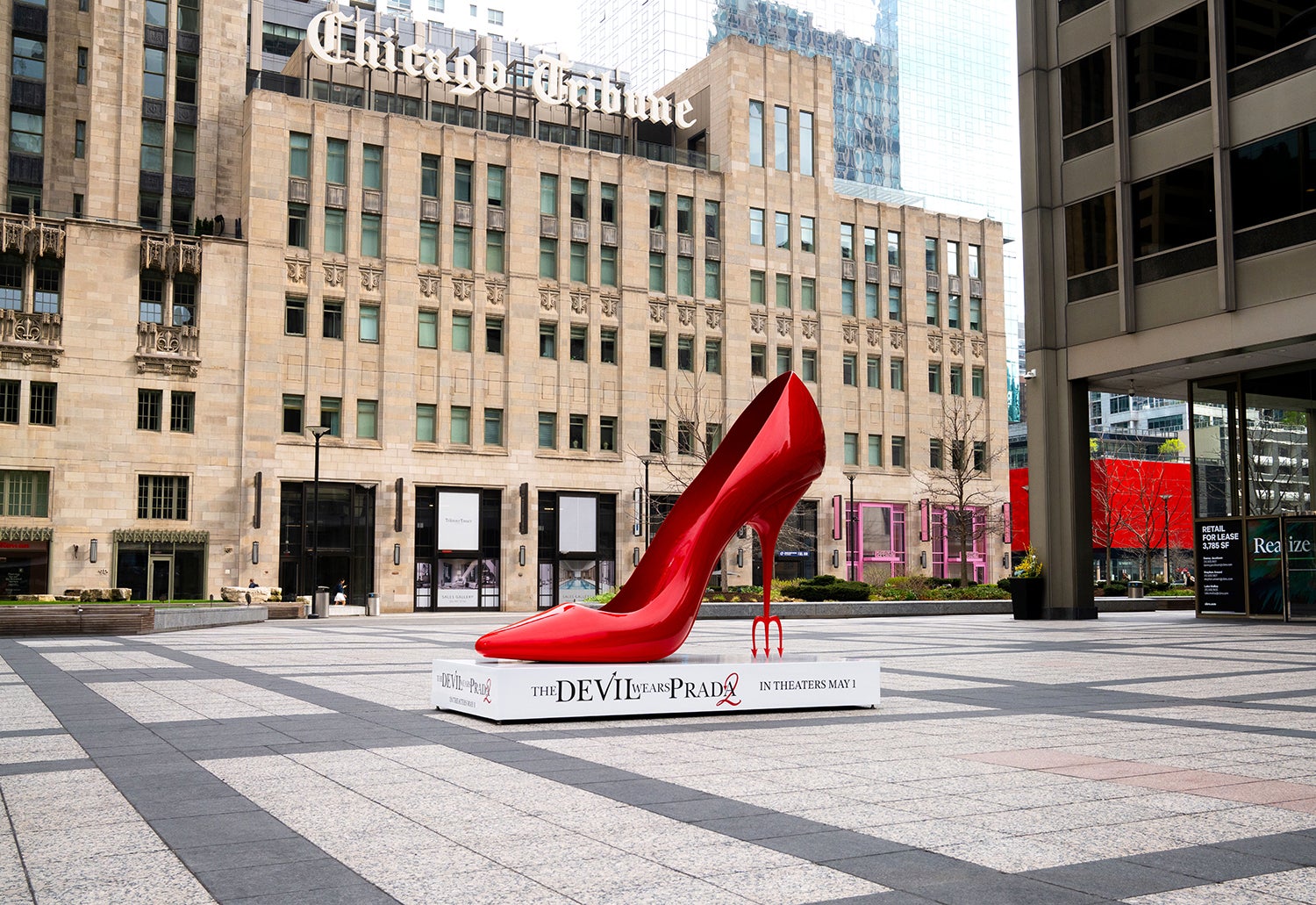
The giant red shoe tour as a physical icon The oversized red heel with a pitchfork-style stiletto takes one of the franchise's most recognizable visual cues and turns it into a mobile PR asset. That matters. It gives press, creators, and fans a shorthand image they can photograph instantly and understand without explanation. The campaign is not just referencing the film. It is building a touring symbol designed to travel across cities and feeds. (Source: Disney / 20th Century Studios Official Press Kit)
Runway Magazine as collectible world-building The 90-page physical Runway magazine distributed through pop-up newsstands is a smart operator move. It turns fictional media into a tactile artifact people can hold, queue for, post, and keep. That extends the film world off-screen and gives the campaign a format built for earned media, UGC, and scarcity. (Source: Disney / 20th Century Studios Official Press Kit)
Smartwater Cerulean as challenge-led participation The smartwater "Cerulean" bottle challenge pushes the campaign beyond viewership into participation. It gives fans a clear behavior, a recognizable prop, and a reason to create their own version of the moment. That is how a brand tie-in starts acting like a social mechanic instead of a static placement. (Source: Disney / 20th Century Studios Official Press Kit)
This is the difference between placement and activation. One rents attention. The other builds association.
The Operator Playbook: Integration Over Placement
If you want a partnership to perform, the bar is higher than exposure. You need a campaign strategy that moves through three stages.
1. Activate
Start with the role the brand plays in the world.
Define the narrative job: What does the partner add to the moment, scene, or audience experience?
Build around a creative anchor: A vignette, a character tie-in, a visual symbol, a product behavior.
Shape assets like a system: Social, paid, experiential, PR, retail, influencer, and CRM should all pull from the same core idea.
2. Amplify
Once the activation is live, extend it across channels with control.
Connect teams early: Brand, studio, social, PR, retail, paid media, and partnerships need one operating plan.
Design for cultural spread: Give people moments worth reposting, reacting to, and referencing.
Protect the aesthetic: Especially in beauty or fashion-adjacent campaigns, visual discipline matters. Every touchpoint should feel intentional.
3. Convert
Attention without a next step is a leak.
Map the journey: Where does interest go after the cultural moment lands?
Create the handoff: Landing pages, commerce moments, audience capture, and remarketing paths should already be in place.
Measure the full impact: Track not just impressions, but lift in search, engagement quality, lead capture, sales influence, and brand preference.
That is how brand activation strategies turn into growth. Not by appearing once. By moving people from awareness to action in a connected system.
Moving with Intentionality
The lesson is simple. Brand partnerships work harder when they are treated like cultural design, not media inventory.
DWP2 offers a sharp example of what happens when a campaign strategy is curated with discipline. They extend the fantasy and give the audience more world to step into.
If you are investing in sponsorships, entertainment partnerships, or high-visibility launches, the question is not just who you signed. It is how the work shows up. Are you buying placement, or are you building an integrated marketing strategy that can activate, amplify, and convert?
Why Brands Call Signal & Story
Marketing leaders bring us in for four specific reasons. They have a high visibility campaign on a tight deadline. They need partnership and speed for a strategic marketing initiative. They are dealing with fragmented marketing across teams. They are looking to breakthrough in culture.
Our model is built for this. We are a project based, full service partner. We don't want to be another agency on your roster.
We bring a curated team of experienced marketers who understand the stakes. We don't deliver 100 page decks that gather dust. We deliver Go-To-Market Sprints and Integrated Campaign Builds that launch on time and with impact. Whether you are navigating a brand partnership or breaking into a new market, we ensure the execution matches the ambition.
Explore our work and see how we've turned brand partnerships into execution that lands.
Comments